

Spinmama experiences In Germany
Author: Daniel Hart
Daniel Hart writes about online casinos, user behavior, game libraries, payment processes, and responsible gaming for readers in Germany.
Spinmama is available in Germany for adult players and shows how lobby, checkout, and game speed fit together in everyday life.


Bonuses and Promotions
100% up to 500€
+ 200 Free Spins

55% up to 150€
+ 100 Free Spins

50% up to 500€

Maximum 25%
Every Monday

Table of Contents
About Spinmama
| License | MGA / Curaçao |
|---|---|
| Games | 2,000+ |
| Minimum Deposit | $10 |
| Withdrawal | 24–72 hours |
| Support | 24/7 Live Chat |
Game Providers








Why First Impressions Often Say More Than Any Number
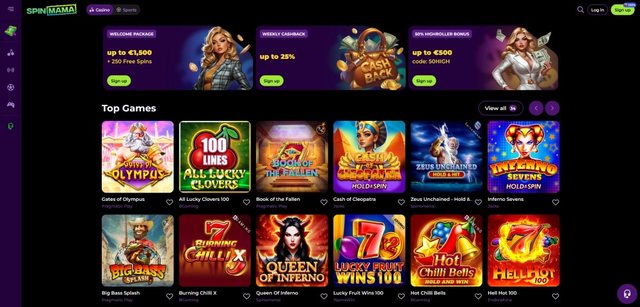
When opening an online casino for the first time, people rarely look for a deep analysis immediately. It's usually about something much simpler: Does the platform feel readable or not? Within the first few minutes, it's decided whether categories make sense, whether the checkout is easily visible, and whether returning to the account works without frustration.
Imagine coming home in the evening, having little time, and not wanting to waste ten minutes searching. If the homepage then seems too loud, the most important paths remain unclear, and every second action looks like a step into the unknown, the desire immediately diminishes. Many players notice at exactly this point whether a platform guides them calmly or whether they have to actively fight against the interface.
Therefore, the first impression is not created in a single game, but in the structure preceding it. Where are the main categories located? Is the navigation immediately understandable? Can the checkout, profile, and help be found without detours? These questions seem small but often carry the entire experience.
Account, Checkout, and Game Start Must Converge
Many sessions become restless not where the game begins, but where the account, checkout, and start logic do not mesh cleanly. Adult players usually notice this quickly. First, one area is opened, then another, then suddenly the overview of the balance is missing, and in the middle of the evening, something has to be looked up that should have been clear before the first click. This creates unnecessary friction.

Imagine you just want to play briefly and only realize in the middle of the process that you don't know exactly where limits, account information, or previous transactions are located. Then a leisure decision suddenly becomes administrative work. Many players therefore fare better if they reverse the order: first read the account, then the checkout, then the game selection. This small adjustment seems trivial but changes the entire pace.
The account area is more than a place for personal data. It shows whether later steps are likely to run smoothly. Are instructions clear? Is support quickly accessible? Are there tools for breaks and budget limits in a visible place? Those who check this early will have to improvise significantly less later. This is exactly what makes the evening feel calmer and less reactive.
What Really Helps Before The First Deposit
Before a deposit, no grand strategies help, but three simple questions: How long should the session last? Which amount fits exactly this time window? And am I currently attentive enough to make a conscious decision? These questions save more stress than one initially thinks because they bring money and time back together.
Imagine someone quickly topping up credit while messages are coming in and the TV is on in the background. At exactly that moment, amounts are guessed rather than chosen. Those who make the same deposit five minutes later in peace almost always start with a clearer head.
Why Fixed Time Slots Avoid Small Conflicts
Many players set a budget, but not a real endpoint. Then, although money is limited, the session itself remains open. This sounds harmless but quickly becomes noticeable in practice. Without a time frame, every further click becomes easier, every switch more likely, and every small extension unnoticeable.
Imagine you only wanted to take a quick look and an hour later see that it was never really decided when to stop. At exactly this point, an open evening becomes tedious. A fixed time slot shifts this dynamic. Those who know beforehand whether twenty minutes or ninety minutes are intended will also choose game speed, category, and bet amount more consciously.
How To Immediately Recognize Calm Navigation
Calm navigation doesn't mean everything has to look minimalist. It means something more practical: the user must know where to go next without constant thinking. Imagine you accidentally leave an area and want to go back without having to search again. If this path seems natural, it's a good sign. If even small changes in direction create haste, the entire evening will be more difficult later.
Popular Games










Contextualize Spinmama Opinions In Everyday Life
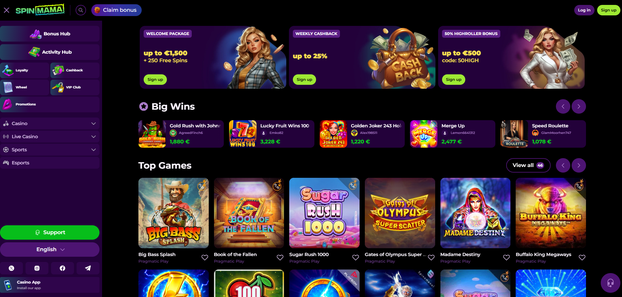
User opinions are particularly helpful when they are not read as a final judgment. Many people look for a quick yes or no in experience reports. In everyday life, however, other things go further: recurring patterns, small hints at stumbling blocks, frequently mentioned strengths in navigation, checkout, game rhythm, or support. Such observations are often more valuable than extreme individual opinions.
Imagine comparing two platforms on the same evening. Both look similarly tidy at first glance. However, with one provider, feedback repeatedly describes the same small frictions - restless paths, hectic entries, diffuse account areas. With the other, it appears more often that the platform is easier to read. Exactly these differences later determine whether an evening feels fluid or cumbersome.
It is also important to consider your own situation. Those who play almost exclusively on mobile should weigh comments about phone use differently than someone planning longer evenings on a laptop. Those who prefer short sessions will find other things important than players with a lot of time. User opinions therefore become truly useful when they are read not in isolation, but in relation to one's own style.
What Recurring Patterns Actually Reveal
A single critical sentence can mean many things. Mood of the day, impatience, or a misunderstanding are often enough. However, if the same points appear multiple times, attention is warranted. Imagine different users independently reporting the same interruptions in the process. Then there is much to suggest that not only individual moods are visible, but real frictions in the structure. This is precisely why one should pay less attention to volume and more to repetition in experience reports.
Consider Mobile Use, Pace, and Mood Together
Mobile use seems practical but also changes behavior. People scroll faster on their phones, compare less patiently, and are more likely to jump between areas. This is not automatically bad, but requires closer planning. Those who use the same open approach as on a desktop quickly notice how the smallest detours on a small screen suddenly become twice as annoying.
Imagine opening the platform briefly while food is in the oven or just before going to bed on the sofa. In such moments, a huge selection doesn't help, but a clear plan does. A familiar category, a manageable framework, a visible end. Many players make the mistake of wanting to test everything at once.
Your daily mood also belongs in this consideration. If you're tired, you read interfaces differently. If you're playing under time pressure, you react faster. If you're already mentally distracted, you're more likely to click spontaneously than choose consciously. Good usage therefore doesn't mean always having the same strategy, but using the platform according to your own state of mind.
Game Situation | Meaningful Start | Why This Helps |
Short evening after work | A familiar category | Saves search time and keeps your mind clear |
Longer quiet session | One main area plus reserve | Brings variety without hectic jumps |
Mobile use on the go | Set a shorter time window in advance | Better suited for small screens |
Little energy in the evening | Slower pace and less switching | Prevents unnecessary stimuli |
Small planned budget | Choose amount first, then category | Keeps the process understandable |
How To Build Mobile Sessions Smaller And Better
Many mobile sessions fail not due to technology, but due to a lack of framework. Imagine you have fifteen free minutes and still open three categories in parallel, take a look at the checkout, and compare several game types. Then a small window becomes a restless block. Those who play on mobile almost always benefit from a smaller structure: one goal, one category, one end.
When Less Choice Is Suddenly More Pleasant
More offer sounds good, until it appears at the wrong moment. When a player is tired, short on time, or already half distracted, a narrower selection often feels much better. Imagine having to choose between three suitable options or between thirty. The larger quantity is objectively broader, but it is not automatically more helpful. This is often the same in casinos.
Why A Switch Doesn't Always Improve Things
Switching between categories can be sensible if the character of the session has truly changed. However, it often happens out of impatience. Imagine a player giving a direction hardly any time and already jumping to the next area because the first minute didn't immediately seem perfect. Then the switch rarely improves anything. It just shifts the restlessness. It works better when there is a real reason – such as a different desired rhythm or a clearly changed mood.
What Support Should Provide At The Right Moment
Support is best when it keeps small questions small. Imagine that in the middle of a session, an account movement seems unclear or an area reacts differently than expected. If help is quickly accessible and contact works practically, the irritation remains manageable. However, if you have to search for a long time, a short question quickly becomes a bigger disruptive factor.
A good inquiry doesn't need long texts. What happened, when did it happen, in which area, and was money directly involved? Those who clearly state these points usually get useful guidance faster.
Spinmama Aligning Reviews With Your Own Style
Opinion terms that sound foreign often appear in search queries because many players use multiple languages in parallel or want to research more broadly. For practical evaluation, however, the core remains the same: Which observations fit my own usage style, and which are just marginal notes for me? Those who don't make this distinction may gather a lot of impressions but gain little clarity.
Imagine reading ten short comments one after another, all pulling in different directions. Without your own framework, only a vague feeling usually remains afterward. With a framework, it looks different. Do I play more on mobile or stationary? Do I have short or long sessions? How important are clear account movements to me? Such questions filter experiences much better than the sheer volume of opinions.
Especially with mixed international search terms, sobriety is therefore helpful. It's not about giving every detail the same weight. It's about connecting recurring hints with your own everyday life. Only then does a broad search become a useful decision-making aid.
Responsible Gaming Starts Before The First Click
Responsible gaming is often thought of too late. Many associate it only with emergency brakes for difficult moments. In reality, it begins much earlier – with the structure of the evening. Those who set the budget, time window, first category, and possible stopping points in advance remove a large part of the uncertainty from the later course. This is not a moral add-on, but a practical form of order.
Imagine a planned half hour gradually turning into a long evening, just because the smartphone remains within reach the whole time. This is exactly where the limits of spontaneous use become apparent. If no guardrails were set beforehand, the situation itself often takes the lead. However, those who know approximately how the evening should look before the first game are much less likely to get stuck in open loops.
Breaks, time limits, and longer interruptions are therefore not just tools for exceptional situations. They also help when an evening simply becomes unfocused. When the same areas are opened multiple times, when decisions are made purely out of habit, or when the platform seems more like an automatic process than conscious use, a break is often more sensible than another round.
The courage to not even start on a particular evening also belongs to this. Not every free minute is a good moment for a session. Those who notice that fatigue, frustration, or inner restlessness are too strong don't have to make a drama out of it. Sometimes, exactly this omission is the most mature decision of the evening. Good platforms support not only the start, but also the clear end.
Frequently Asked Questions
It's best not to look for a single definitive answer, but for recurring patterns. A single enthusiastic or very critical text can be misleading; several similar observations are usually more informative. Imagine different users independently mentioning the same strength or the same friction. That's exactly when it's worth taking a closer look, because it often leads to a realistic everyday picture.
Not necessarily on every visit, but it's often useful. Especially if a deposit is planned or the existing balance influences the evening's character. Imagine you only want to play a short session but haven't checked the financial framework beforehand. Then the evening lacks structure from the start.
A break is usually wise when the evening no longer feels conscious. When decisions become faster, the same areas are opened multiple times, or the overview noticeably decreases, distance often helps more than another attempt to regain rhythm. Imagine you just keep clicking without really knowing why. That's often the best signal for an interruption.
In many cases, yes, because small screens encourage faster behavior. People scroll more, compare less patiently, and are more easily tempted to make spontaneous changes. Imagine you play briefly on the go and have to pay attention to time and surroundings at the same time. Then a tightly planned session almost always works better than an open-ended evening without a clear end.
Primarily by how it behaves in normal situations. Not in a perfect test moment, but when you are tired, have little time, or just want to check something quickly. If your account, cashier, and help are still clearly accessible, that's usually a good sign. Imagine opening the platform after a long workday and still finding what you need immediately. That's when real everyday suitability is shown.
Because money alone doesn't structure the evening. Those who set an amount but no end point leave half the session open. Imagine you know how much you want to spend, but not how long the evening should last. Then there's too much room for spontaneous extension. A fixed timeframe closes exactly this gap and often makes decisions calmer.
Four things are useful: the budget, the time window, the first category, and the point at which you want to briefly check if the evening is still coherent. Imagine starting without these cornerstones. Then every decision has to be made anew in the middle of the session. Those who set the basics beforehand usually experience longer evenings much more orderly.